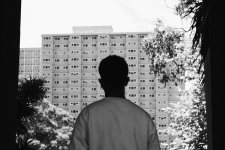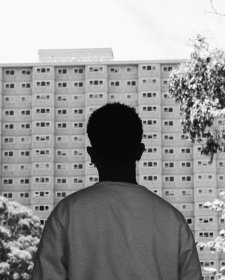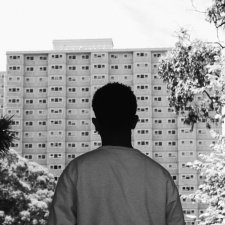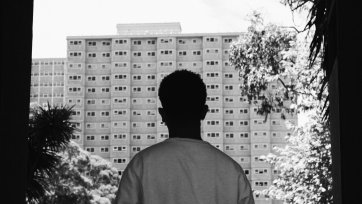
Look
- Invite students to use drawing as a way of closely observing the portraits.
- Ask students to create a continuous line drawing while looking carefully at one portrait. Encourage them to focus on shapes, lines and details without lifting their pencil.
- Remind students that this is about capturing key features and forms, not replication.
Discuss
- Invite students to work in small groups and select one portrait to discuss in more depth.
- Ask students to share interpretations and explore how each artist represents themselves.
Discussion prompts:
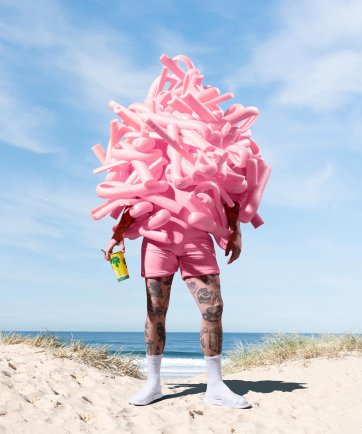
- Gerwyn Davies’ Bather: why do you think the artist chose to hide parts of their body from the viewer?
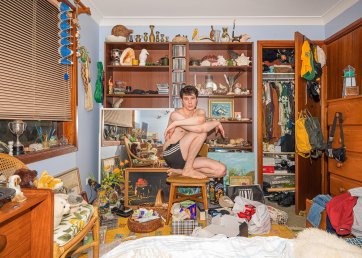
- Tom Zust’s Self portrait collecting dust: how does the location add to the artist’s personal story?
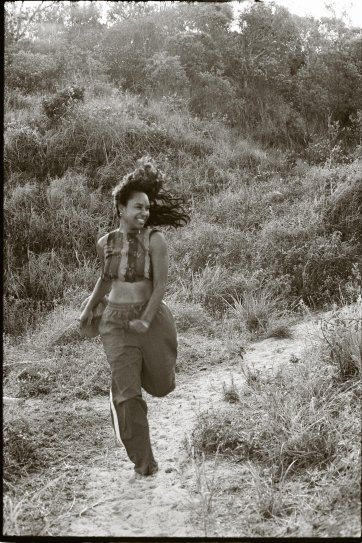
- Tiarni Majid-Loban’s Eldest daughter’s freedom: what words would you use to describe the feeling this portrait evokes?
Connect
- Invite students to read the artist statement for one of the portraits and reflect on the connections between the artist and themselves.
- Ask students to consider how identity, experience and perspectives shape the work.
- Students could create a mind map to record their connections.
Inquiry prompts:
- In what ways are we similar?
- In what ways are we different?
- In what ways can I connect with them?
- What would you ask, say or do with them if you had the opportunity to meet?
Create
- Invite students to create their own photographic self portrait inspired by the ideas explored by the three artists.
- Encourage them to think about how identity can be expressed visually and conceptually.
Creative prompts:
- How can you explore the visible and invisible aspects of your identity?
- How can you give power to yourself as the subject?
- How will you capture a feeling or a moment in time?
- How can you use objects and place to express your personal story?