



© National Portrait Gallery 2026
King Edward Terrace, Parkes
Canberra, ACT 2600, Australia
Phone +61 2 6102 7000
ABN: 54 74 277 1196
Search / henri van raatle


Purchased with funds provided by L Gordon Darling AC CMG 2009

Henri van Raalte (1881-1929), etcher and curator, moved to Western Australia in 1910 having trained in his home town of London and at schools in Belgium and Holland.
1 portrait in the collection


Collection: National Portrait Gallery
Purchased 2010


Gift of Alice Giles AM, in memory of her mother Rosemary Madigan 2023


Collection: National Portrait Gallery
Gift of the artist 2005


Collection: National Portrait Gallery
Purchased 2018


Gift of the artist 2025. Donated through the Australian Government's Cultural Gifts Program.

National Gallery of Australia curator Jane Kinsman discusses the portraiture of Henri Matisse.

Jacques Henri Emil van Meegeren was a Dutch illustrator and painter. He is the the son of the infamous art forger, Han van Meegeren [Henricus Antonius] (1899-1947) who produced several paintings in the 1930s and 1940s which he passed off as originals by Vermeer , Pieter de Hooch and others..
1 portrait in the collection

Antoine Fauchery (1823–1861) was a Parisian artist and writer, an occasional collaborator with Henri Murger, author of Scènes de la vie de bohème which was a chief source of the opera La bohème.
2 portraits in the collection

Henri-Cartier-Bresson invented the grammar for photographing life in the 20th century.
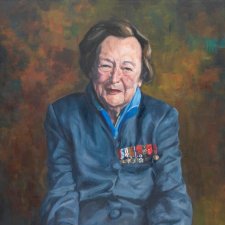
Nancy Wake AC (b. 1912), one of the most decorated women of World War 2, earned the name the 'White Mouse' for her maddening ability to evade the Gestapo.

Press releases and images downloads for media.
Nancy Wake AC (1912–2011) was one of the most-decorated women of the Second World War.
1 portrait in the collection

Michael Kimmelman, Chief Art Critic of The New York Times and author of Portraits: Talking with Artists at the Met, the Modern, the Louvre and Elsewhere, presented the National Portrait Gallery Third Anniversary Lecture on 2 March 2002. He was generously brought to Australia by the Gordon Darling Foundation and Qantas.

It was definitely a candid encounter as was the expression on the face. It was constructed insofar as the image was deliberately taken from a distance so as to minimize intrusion and to magnify the effect of the image.