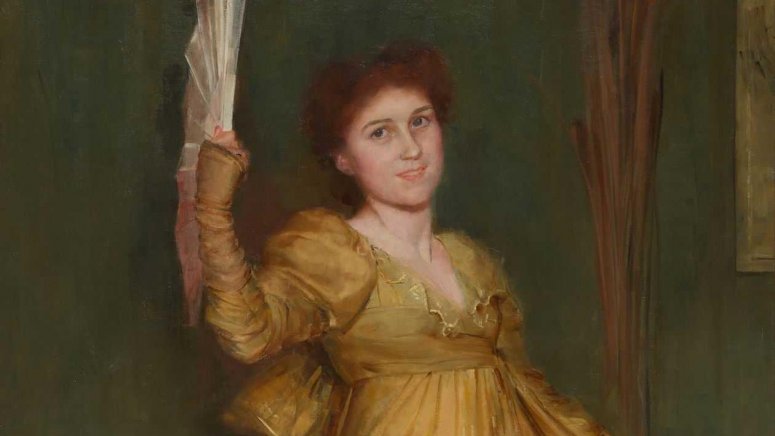
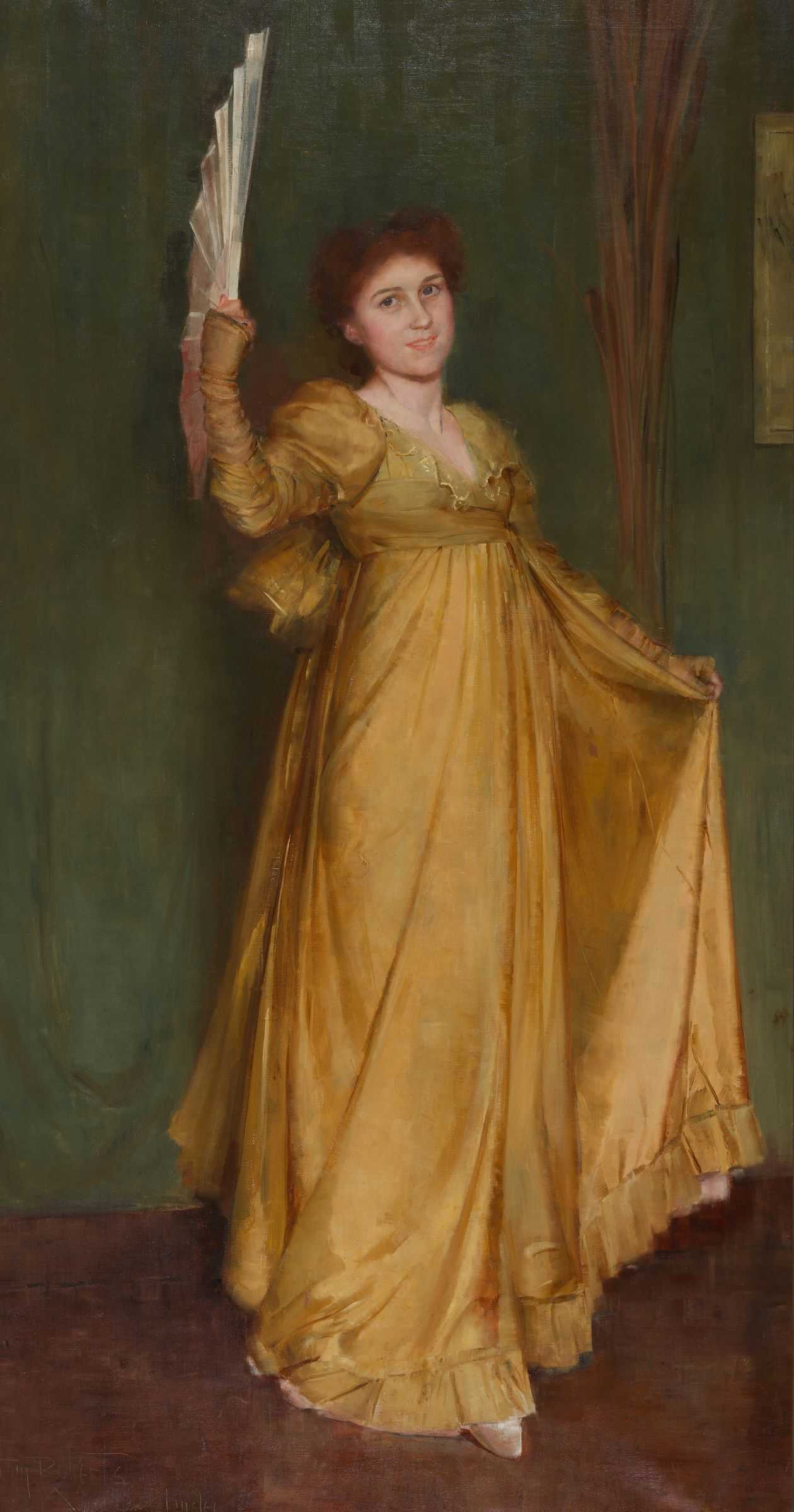
Tom Roberts had a profound influence on Australian art, promoting the principles of Impressionism and painting en plein air (outdoors). He also advocated for quintessentially Australian subject matter, as seen in his famous landscape paintings such as Shearing the rams and A break away. But Roberts was also one of Australia’s foremost portraitists. His portrait of Hilda Spong (1875–1955) was painted in 1893, when the actor was around 18 years old. Following success in Australia and New Zealand, Spong left for London in 1896 and later New York, where she appeared in more than 50 Broadway productions between 1898 and 1940. At a time when few Australian performers achieved such global success, she established a distinguished career on both sides of the Atlantic. In Practising the Minuet (Miss Hilda Spong) she stands before a backdrop of rich green drapery and tall ornamental grasses, raising a silk fan as though about to begin a minuet. Her shimmering gold gown, with its fashionable high waist and dramatic leg-of-mutton sleeves, reflects the revival of Empire-style dress during the 1890s. Roberts captures both the theatricality of performance and the poise of a young woman on the threshold of an international career.
Purchased with funds provided by the Ian Potter Foundation 2008

The portrait titled Practising the Minuet (Miss Hilda Spong) is an oil on canvas and stands 203cm high and 117cm wide. This large work of the young performer is housed in a heavy, old, gold frame and modestly embellished with a lapping leaf design on its outer rim. The frame is substantial but not overly elaborate. The oil paint evenly coats the surface of the canvas and has a low satin sheen. The artist has employed a realistic style with some of the brush marks visible creating subtle texture and movement.
Artfully arranged, a glowing Hilda stands centrally, poised as if about to dance.
A background of deep, natural green frames the figure, and covers three quarters of the canvas from top to bottom.
On the top right-hand side of the work, the slim edge of a framed picture is visible however the details are indistinct. Adjacent to Hilda’s left shoulder is a collection of long upward strokes in brown and black with touches of gold indicating some sort of plant reminiscent of rushes, the base of which is obscured by Hilda. The green backdrop seems to be made of fabric, indicated by the suggestion of folds and creases in the lower left-hand corner.
Beneath her feet the hard, polished floor captures some reflected light in varying tones of chocolate, chocolate gold and red brown.
Hilda is a young woman with fair skin, auburn hair clipped up in a loose style and dark eyes that gaze upwards to her right. She has a rosy complexion, pink lips and a gentle smile.
She stands composed, her right foot pointed forward, and left hand gracefully holding out the sweep of her dress. In her right hand, raised up level with her eyes, she holds a large splayed white fan, extending above her head and trailing parallel to her angled body. The fan enhances Hilda’s theatrical pose.
Hilda is wearing a flowing golden, empire-line dress, extending to the tips of her toes. The v shaped neckline is trimmed with lace of the same golden hue as the dress. A section of fabric wraps around her chest, it ties in large bow peeping from behind her back and trails the length of her skirt. The sleeves, puffed at the shoulder, fit tightly along her arm and extend to below the elbow. She is wearing long, fingerless evening gloves, typical of the time.
Barely visible in the bottom left hand corner is the artist’s signature, scratched into the surface of the paint.
Audio description written by Sally Adair and voiced by Emma Bedford
The Ian Potter Foundation (9 portraits supported)
On one level The Companion talks about the most famous and frontline Australians, but on another it tells us about ourselves.
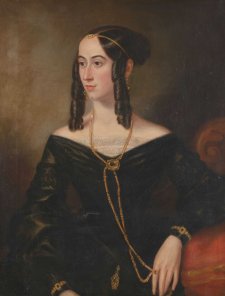
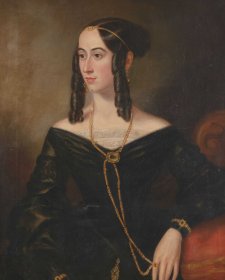
Emma Kindred examines fashion as a representation of self and social ritual in 19th-century portraiture.

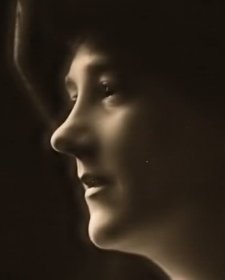
Broadway star Miss Hilda Spong was painted by Tom Roberts in 1893.